Weather Monitoring System Using Internet of Things - Juniper publishers
Journal of Trends in Technical and Scientific Research

Abstract
In this research, a foundation is set for an
efficient solution for tracking the weather conditions of a specific
location and making the information available anywhere in the world. The
technological advances behind this is Internet of Things (IoT), which
is an efficient and effective solution for linking the things to the web
and to connect the entire world of things in a network. Here things
could be like electronic gadgets, sensors, and automotive electronic
devices. The system functions with tracking and monitoring environmental
circumstances such as temperature, relative humidity, light intensity,
pressure and quantity of rainfall with sensors and whenever these scores
exceed a selected threshold limit for each an e-mail, an SMS alerts the
appliance owner to take the required steps
Keywords: Smart Environment; Internet of Things Weather Monitoring System Cloud
Introduction
Present technological innovations focus primarily on
managing and tracking various operations. To achieve human needs, these
are increasingly emerging. To monitor and evaluate the circumstances in
case of exceeding the prescribed level of parameters (e.g. noise, gas
and radiation levels), an effective environmental monitoring system is
needed. When objects such as environment embedded with sensor devices,
microcontroller and multiple software applications become an environment
of self-protection and self-monitoring, it is also called a smart
environment. In such an environment the alarm or LED alerts
automatically occur when some incident happens. The impacts on
livestock, crops and humans due to the environmental modifications can
be tracked and regulated by a smart monitoring system for the
environment. By making the environment interactive with other objectives
by using embedded intelligence, this is one of the applications that
targets smart environment. Human needs are dependent on the type of
information collected by the sensor devices, different kinds of
monitoring systems. The two categories to which applications are
categorized are based on event detection and spatial process estimation.
Initially, sensor systems are implemented in the environment to detect
parameters (e.g., temperature, humidity, pressure, LDR, noise, CO and
radiation levels, etc.) while acquiring, computing and controlling
information (e.g., noise and gas levels variations in the specified
levels).Sensor devices are positioned at various places to gather
information to predict the behavior of a specific area of interest. Here
Internet of Things (IoT) is the concept of linking all the sensors to
the internet [1]. The primary purpose of this document is to develop and
execute an effective monitoring system whereby the necessary parameters
are remotely controlled using the internet and the information
collected from the sensors are stored in the cloud and analyzed there
and then an email, an SMS alerts whenever the threshold limit exceeds
[2].
Materials and Methods
Problem Statement
The satellite weather reporting system provides the
current condition that does not give the exact location condition. The
drawbacks are in conventional approach where the devices are costly and
have no visualization of information. There is no such automatic tool to
offer the alert signal in case of any abnormalities, so it is difficult
to regulate this abnormality
Proposed Model
Weather conditions are tracked in the home’s external
environment or any buildings and information are transferred to the
cloud server. The benefits will be that this system will manually
transmit the real-time environment information. It is possible to view
the information in any part of the world. This application isto monitor
and update the condition of the surroundings regularly.
Conditions of the environment can be tracked by gathering the
data from the sensors and deposited in the cloud and analyzed
there and then an email, an SMS alerts if the situation of the
environment
becomes abnormal.
Environment Monitoring System
An IOT application is used to monitor the environment that
helps monitor the environmental condition of any local area or a
surrounding area, and with the help of the internet everyone can
view the condition. This application is more efficient, quicker in
offering conditions for the environment [3]. It enables people or
government to take remedial action if the environmental condition
becomes abnormal. Environmental condition monitoring
system offers a technique for verifying the condition and changes
occurs over the surrounding. In this system we use Arduino, sound
sensor, gas sensor, temperature sensor, moisture sensor, pressure
sensor, IOT module. The humidity and temperature sensor will
track climate change and provide information. It is helpful for agriculture
[4]. To monitor pollution over the atmosphere, the gas
and sound sensor are used. Currently, pollution from air and noise
makes the environment more susceptible. Using this module,
we can identify the polluted area and expressly create people’s
consciousness for living in the pollution. Changes in the climate
system cannot be accurately defined and sometimes accidentally
defined, but with the help of an IOT module we can characterize
more approximate changes in an environment and update them in
the cloud. This system uses many modules as follows:
Sensor Module:
The sensor network is linked to a hefty
amount of small sensor nodes that can be used as an effective tool
for collecting information for different applications under different
situations [5,6]. Different sensors are integrated into this
study that has its distinctive way of collecting information from
the surroundings. An integrated circuit sensor (LM35) used to
evaluate temperature with an electrical output proportional to the
temperature (in oC). If the temperature goes up, the fan is going on
and vice versa. The factor of scale is .01V / oC. The LM35 requires
no external calibration or trimming and retains a +/-0.4oC accuracy
at room temperature and +/-0.8oC over 0 oC to+ 100 oC range.
System utilizes moisture sensors DHT11. It provides outstanding
quality, quick response, capacity to prevent interference,
and cost-effectiveness. On the calibration of humidity, this sensor
is highly precise.
MQ-6 gas sensor’s sensitive material is SnO, which has lower
conductivity in clean air. The MQ-6 gas sensor is highly sensitive
to Propane, Butane and LPG, as well as natural gas response. The
Sensor could be used to detect various fuel gases, particularly
methane; it is appropriate for separate applications at a low price.
The sound sensor module offers a straight-forward sound
monitoring technique and is generally used for sound power detectiondetection.
This module can be used for apps for safety and tracking.
Its precision for comfort of use can be readily adapted.
The BMP180 is an I2C standard device and a pressure sensor.
It’s a 4-pin tool, i.e., SDA, SCL, VIN, GND. The connection between
Vin and GND is 3.3V and GND. SDA connects to the nodemcu D2
pin and SCL connects to the nodemcu D3 pin.
Power Module:
The Power for the system can be provided via
the adapter or the USB. Use the USB cable or an external power
supply to power the Arduino board. Source of power can be selected
automatically.
Controller Module:
This implementation is controlled by
Arduino UNO. The Arduino board transforms to digital data the
analog data produced by the sensor. Arduino is generated to monitor
or comprehend the environment or surroundings by receiving
feedback from a variety of sensors and can impact its atmosphere
by controlling lights, engines, and other actuators. The board’s
microcontroller is programmed using the Arduino programming
language and Arduino development environment. Arduino projects
can be separated or when operating on a desktop they can
interact with software.
IoT Module:
The IoT board is intended to satisfy a range of
online application demands with different benefits that allow the
embedded system designer to readily, rapidly and seamlessly add
internet connectivity to their applications. The module’s UART
update feature and webpage management make them excellent
for online wireless applications like environmental sensors and
information from moveable battery-operated wireless sensor network
devices. Lumisense IoT board is designed with SIM900 GPRS
modem for active internet connection so that it is equipped with a
controller for processing all UART data based on GPRS online data.
Light Dependent Resistor (LDR):
An LDR is a light-controlled
variable resistor. The LDR’s strength is reduced by the increasing
light intensity falling on it. It has an analog output that is
an input to the nodemcu’s A0 pin.
Raindrop Module:
It is used for rain detection. It can also be
used to measure rain intensity. It has both digital and analog output.
This module analyses the moisture by means of analog output
pin and gives a digital output when the moisture limit exceeds
too much. The more water or less resistance implies the reduced
voltage of the output. Whereas, the less water implies higher resistance,
i.e, high output voltage on the analog pin. For instance,
a totally dry board will result in five volts of module output. The
module’s analog output is linked to the nodemcu’s A0 pin.
Working of the Analog Pin (A0):
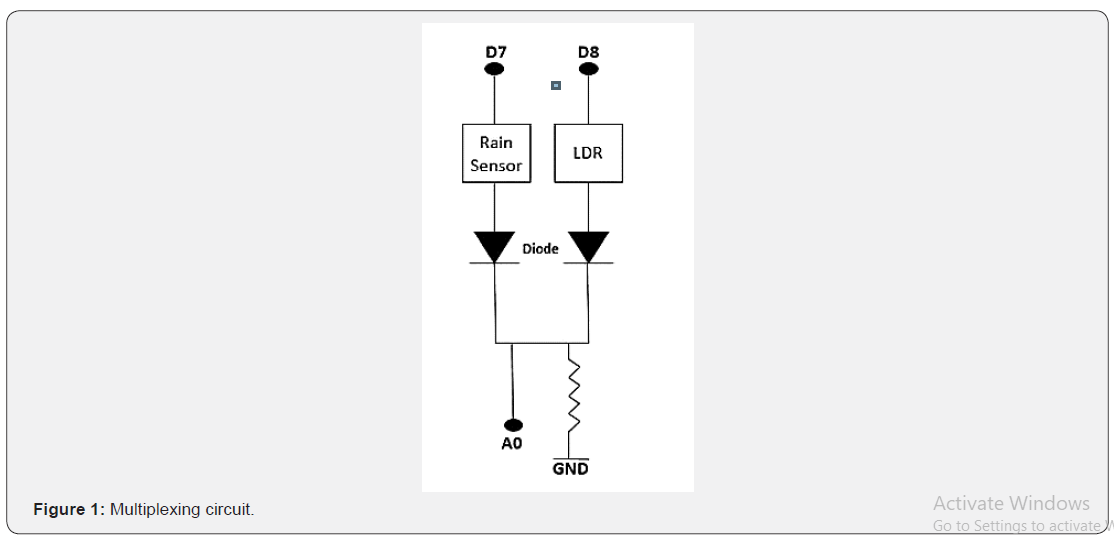
The Nodemcu board has
only 1 analog pin, but two analog output devices, viz, LDR and
Raindrop module, are multiplexed to the A0 using two diodes in
this project. The circuit of multiplexing is shown in Figure 1 below.
Here the Raindrop Vcc sensor is connected to the nodemcu
D7 and the LDR input is connected to the nodemcu D8. When D7
is high, D8 is low, making LDR off and module raindrop on. Thus,the raindrop sensor output reaches the nodemcu A0 through the
diode. Similarly, when D8 is high and D7 is low, the LDR is on and
the raindrop module is off creating a route for the LDR output to
achieve the nodemcu A0 through the second diode.
Execution
Arduino is driven by a USB cable and the four sensors are
linked to the Arduino board and the information collected from
the sensors is stored in the cloud and analyzed there and then an
email, an SMS alerts whenever the threshold limit exceeds. The
IoT module is also linked to the Arduino board to receive feedback
from the sensors and is driven by the adapter. The USB cable givespower to the Arduino board and then transfers information from
Arduino board to the computer
Results
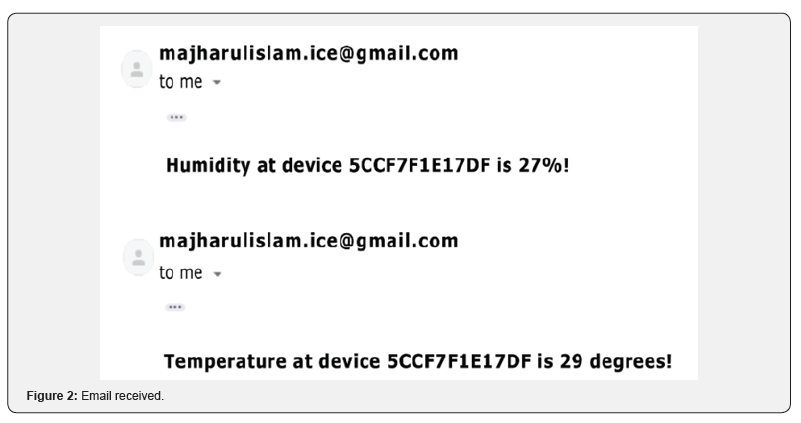
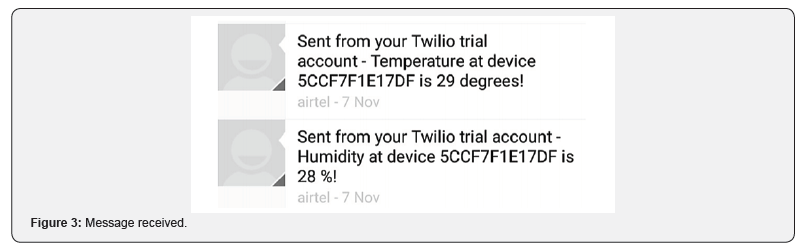
Once the sensor measures are downloaded to the cloud, the
values are evaluated and then the threshold limit exceeds an
e-mail, an SMS and a tweeter post are posted. Some findings of the
study are as follows Figures 2 & 3.
Algorithm 1:Analog Pin Multiplexing
Input: LDR D8, raindrop D7;
Output: Analog pin A0
loop {
if (digitalRead(D7) == HIGH)
{
A0=raindrop sensor value;
digitalWrite(D7, LOW);
}
else if (digitalRead(D8) == HIGH)
{
A0=LDR value;
digitalWrite (D8, LOW);
}
}
Algorithm 2:E-mail, SMS
Input: temp, humidity, press, LDR, rain;
Output: email, sms
loop {
temp=temperature value measured;
humidity=humidity value measured;
press=pressure value measured;
LDR=light intensity measured;
rain=rain value measured;
if (temp && humidity && press && LDR && rain)
{
publish all the measured value to the cloud bluemixserial.println(temp);
serial.println(humidity);
serial.println(press);
serial.println(LDR);
serial.println(rain);
}
else
{
serial.println(” error! check the sensors.”);
}
if(temp>=40)
{
email=” The current temperature is” + temp;
sms=” The current temperature is” + temp;
}
if(humidity>=50)
{
email=” The current humidity is” + humidity;
sms=” The current humidity is” + humidity;
}
if(rain>=200)
{
email=” It’s raining outside. Bring your umbrella”;
sms=” It’s raining outside. Bring your umbrella”;
}
if(LDR>=150)
{post only once in a day
{
email=” Good Morning”;
sms=” Good Morning”;
}
}
}
Conclusion
This System monitors the changes happening over the
environment and provides enough ways for the users to access
the information from anywhere through cloud. The temperature
and humidity sensor will monitor and gives the details about the
changes happening over the climate. The gas and sound sensor
are used for monitoring the pollution over environment. The
Monitored condition will be updated in the cloud.
To Know More About Trends in Technical and
ScientificResearch Please click on:
https://juniperpublishers.com/ttsr/index.php
To Know More About Open Access
Journals Please click on:



Comments
Post a Comment