Dopplerographic Assessment of Blood Flow Parameters of Vertebral Arteries in Patients with Cervicogenic Headache Due to Arthrosis and Instability of Atlanto-Axial Junction - Juniper Publishers
Journal of Trends in Technical and Scientific Research

Abstract
Introduction: Cervicogenic Headache (CH) is a
syndrome characterized by chronic hemicranial pain that is referred to
the head from either bony structures or soft tissues of the neck.
Factors such as:
i. Stable uncomfortable positioning of the head;
ii. Increased mobility of the upper cervical vertebrae with rotational movements;
iii. A combination of external pressure over the
occipital region and mobility of the cervical vertebrae on the
symptomatic side causes or strengthens the existing headache. The
leading role in the formation of the central nervous system is played by
the irritation of the vegetative plexus of the vertebral arteries.
Objective: Dopplerographic evaluation of blood
flow parameters in vertebral arteries in patients with cervicogenic
headache due to arthrosis and instability of the atlanto-axial junction.
Materials and methods: A retrospective analysis of the results of Doppler ultrasound in the 2nd and 3"1
segments of the Vertebral Artery (VA) was performed in 58 patients aged
21-38 years, who had X-ray and MRI diagnosed arthrosis and instability
of the atlanto-axial junction; among the examined were 21 men and 37
women. The maximum Systolic Velocity (Vs), the end Diastolic Velocity
(Vd), the Resistance Index (RI) in second and third segments of VA in
the neutral spine and flexion position of the neck. The control group
consisted of 27 people aged 19-36 years without chronic headache,
absence of arthrosis of the atlanto-axial junction according to the
results of X-ray or MRI. Dopplerography was conducted on a Philips HD
11XE device using a linear and microconvection transducers in the
frequency range 5-10MHz and 4-9 MHz; MRI - General Electric, Signa HDI,
1.5T.
Results: In the control group in the second segment of the VA, Vs was 50.3±5.1cm/s, RI - 0.61±0.03; at the level of 3rd
segment-48.9±5.1cm/s, RI - 0.58±0.03; at the rotation of the head - Vs
43.6±4.5cm/s, RI - 0.62±0.03, respectively. In a patients with
Atlanto-axial arthrosis in the second segment of the VA, Vs was
48.9±5.3cm/s, RI-0.56±0.03; at the level of 3rd segment -
45.3±4.9cm/s, RI-0.54±0.03; at the rotation of the head- 37.2±4.1cm/c,
RI-0.71±0.04 (P<0.05) respectively. In patients with atlanto-axial
instability at the level of C5-C6, Vs amounted to 49.2±5.1cm/s,
RI-0.59±0.03; at the level of 3-d segment of VA-Vs was 46.1±4.8cm/s, RI -
0.58±0.03. When the head was turned to the side in patients with
instability of the atlanto-axial junction, Vs was significantly lower
compared to the control group (34.1±4.2cm/s and 43.6±4.5cm/s; RI more
then in the second segment of the VA (P<0.05).
Conclusion: Instability of atlanto-axial
junction, especially in combination with arthrosis, is one of the common
causes of cervicogenic headache in young people. The main pathogenetic
mechanism of the onset of pain is changes in blood flow in the third
segment of the vertebral arteries, especially during rotational
movements.
Keywords:
Atlanto-axial junction, Dopplerography, Cervicogenic Headache,
Atlanto-axial arthrosis & instability; Vertebral artery; Sedentary;
Pathogenetic; Migraine features; Phonophobia
Abbreviations:
CH: Cervicogenic Headache; VA: Vertebral Artery; VD: Diastolic
Velocity; RI: Resistance Index; CVMS: Cervical Vertebral Motor Segments;
CHISG: Cervicogenic Headache International Study Group; NFR:
Nociceptive Flexor Reflexes; VA: Vertebral Artery; RI: Resistance Index;
RVAO: Rotational Vertebral Artery Occlusion
Introduction
Cervicogenic Headache (CH) - one ofthe most common,
is due to biomechanical dysfunction of the Cervical Vertebral Motor
Segments (CVMS). It accounts for 15-20% of all headaches. More common in
women (ratio 4: 1); occurs at any age, there is no hereditary
predisposition, the course is predominantly chronic. The CH, as a rule,
suffer from representatives of “sedentary” occupations, as well as those
who in the process of work often have to tilt their head or work with
the dropped. Factors such as:
i. Stable uncomfortable positioning of the head;
ii. Increased mobility of the upper cervical vertebrae with rotational movements;
iii. A combination of external pressure over the
occipital region and mobility of the cervical vertebrae on the
symptomatic side causes or strengthens the existing headache. The
leading role in the formation of the central nervous system is played by
the irritation of the vegetative plexus of the vertebral arteries [1].
The current version of the diagnostic criteria of the
CH is presented in the International Classification of Headache-
Related Disorders (1CHRD-3 beta) in paragraph 11.2.1 (Table 1).
According to 1CHRD-3, CH is a headache caused by a lesion of the neck
(bone structures, disc and/or soft tissues) and is usually accompanied
by pain in the neck. The unilateral character of the headache without a
change of sides, the provocation of a typical pattern of pain by the
external pressure on the neck muscles or movement in the cervical spine,
the spread of the pain from the occipital area to the front temporal
allows differentiating CH from migraine and tension headache.
Nevertheless, the CH may have some “migraine features”, such as nausea,
vomiting, photo and phonophobia, but their intensity and severity is
significantly less than with migraine [2].
The leading pathogenetic mechanism of CH development
is a change in the mobility of the three upper cervical segments. The
leading role in the formation of the central nervous system is played by
the irritation of the vegetative plexus of the vertebral arteries.
There is a significant lack of agreement in the definition of the
diagnosis of cervicogenic headache [3].
The CH diagnostic criteria rely, at least in part, on a patient's
response to diagnostic facet injection blocks. Controlled diagnostic
blocks into the cervical facet joints are invasive, expensive and not
readily available, and so they cannot be considered as useful in most
practitioners' offices. Merging the International Headache Society 1HS
and the Cervicogenic Headache International Study Group (CH1SG) criteria
helped improve the diagnosis of cervicogenic headaches [3].
There is considerable overlap in the clinical
presentations of cervicogenic, migraine and tension-type headaches,
implying that many of these signs and symptoms are not unique to any
particular headache type. Because of these issues, according to Hall
“incorrect headache diagnosis may occur in more than 50% of cases.”
Therefore, it is important that the practitioner carefully keep in mind
competing diagnoses and monitor response to treatment [4].
The traditional diagnosis method of cervical
spondylosis is based on X-ray reading. Based on an analysis of 1034
clinical cases and 60 cases of a test group using digital radiography [5]
increased the diagnostic efficiency of up to 80% of cervical
spondylosis compared with conventional radiography, which diagnosed
spondylosis in 68.3% of cases [5].
Doppler ultrasound imaging is a noninvasive and
useful modality for the examination of vertebral arteries. Color
duplex/Doppler ultrasound is considered to provide a valid and reliable
noninvasive measurement of vertebral arterial blood flow velocity. There
is evidence that Doppler ultrasound measures of vertebral artery blood
flow may be sufficiently responsive to detect changes in cervical
rotations or after intervention. It has been reported that a decrease in
vertebral artery blood flow could be identified by Doppler ultrasound
at both upper and lower cervical levels during end-range cervical
rotation in asymptomatic participants. This indicated that Doppler
ultrasound would be able to detect changes in the vertebral arterial
blood flow velocities decreased when the vertebral arteries are under
stress from compression or stretching. Doppler ultrasound has also been
used to detect improvement in vertebral arterial blood flow velocities
in patients with vertebrobasilar artery insufficiency before and after
medical intervention [5-8].
Based on the study of nictitating and nociceptive
flexor reflexes (NR and NFR) in 63 patients with chronic and 40 patients
with epizodic migraine, Zenkevich AS [9]
concluded that in a large number of patients, neck pain is an
indispensable component of the pathogenesis of chronic migraine [9].
Objective
Dopplerographic evaluation of blood flow parameters
in vertebral arteries in patients with cervicogenic headache due to
arthrosis and instability of the atlanto-axial junction.
Materials and methods
A retrospective analysis of the results of Doppler ultrasound in the 2nd and 3rd
segments of the Vertebral Artery (VA) was performed in 58 patients aged
21-38 years, who had X-ray and MR1 diagnosed arthrosis (26 person) and
instability (32 person) of the atlanto-axial junction; among the
examined were 21 men and 37 women. The maximum Systolic Velocity (Vs),
the end Diastolic Velocity (Vd), the Resistance 1ndex (R1) in second and
third segments of VA in the neutral spine and flexion position of the
neck were determined. The control group consisted of 27 people aged
19-36 years without chronic headache, absence of arthrosis of the
atlanto-axial junction according to the results of X-ray or MRI.
Dopplerography was conducted on a Philips HD 11XE device using a linear
and microconvection transducers in the frequency range 5-10MHz and 4-9
MHz; MRI - General Electric, Signa HDI, 1.5T.
Results
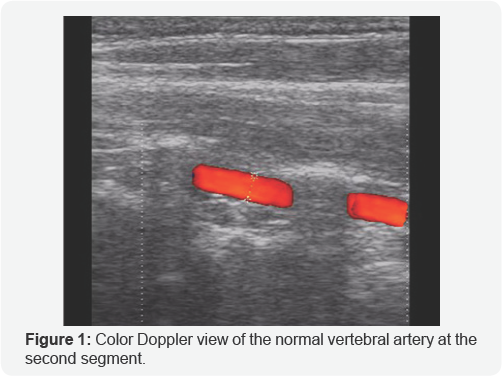
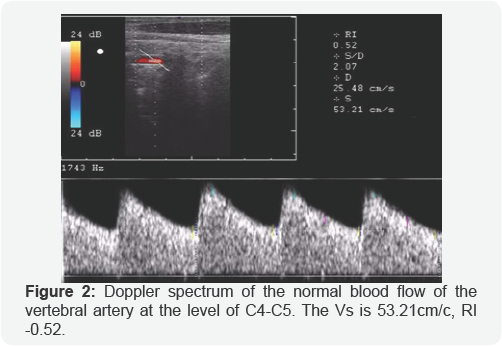
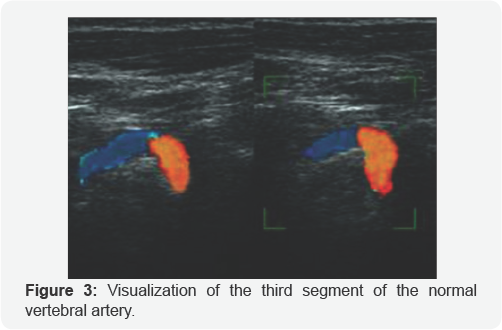
In all subjects, the Doppler blood flow spectrum was
recorded in the second segment (at level of C4-C5), at the third (at
level of lateral atlanto-axial junction) and fourth segments of
vertebral artery in the neutral spine position and also with the head
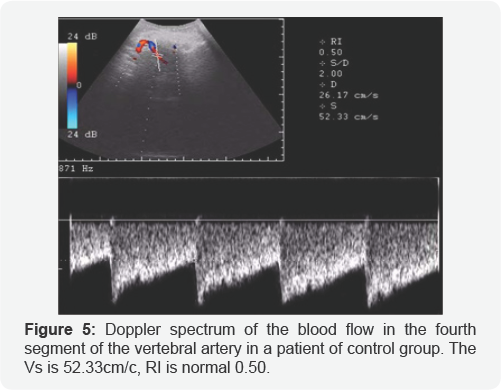
turning to the side. In the control group in the second segment of the
VA, Vs was 50.3±5.1cm/s, RI-0.61±0.03; at the level of 3-rd segment -
48.9±5.1cm/s, RI - 0.58±0.03; at the rotation of the head - Vs
43.6±4.5cm/s, RI-0.62±0.03, respectively (Figure 1-5).
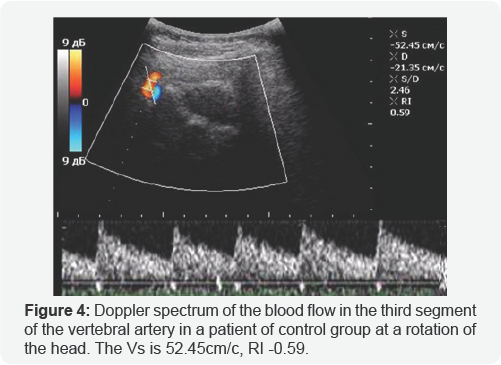
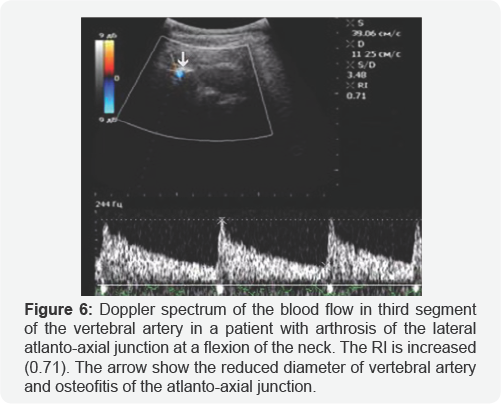
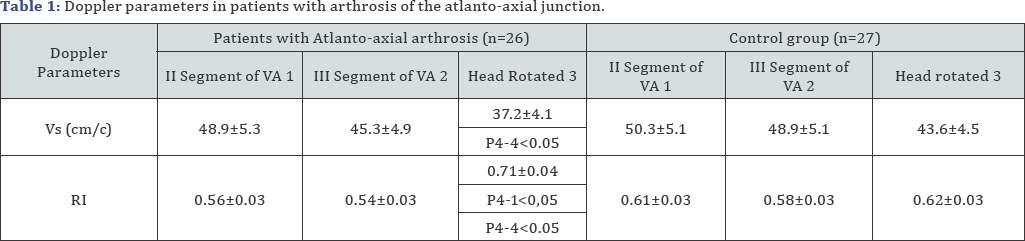
As can be seen from Table 1
in a patients with Atlanto-axial arthrosis in the second segment of the
VA, Vs was 48.9±5.3cm/s, RI-0.56±0.03; at the level of 3-rd
segment-45.3±4.9cm/s, RI-0.54±0.03; at the rotation of the
head-37.2±4.1cm/c, RI-0. 71±0.04 respectively (Figure 6).
RI in patients with arthrosis of the atlas-axial junction with rotation
of the neck was significantly less than in the second segment in these
patients, and VS less than in the control group (P<0,05).
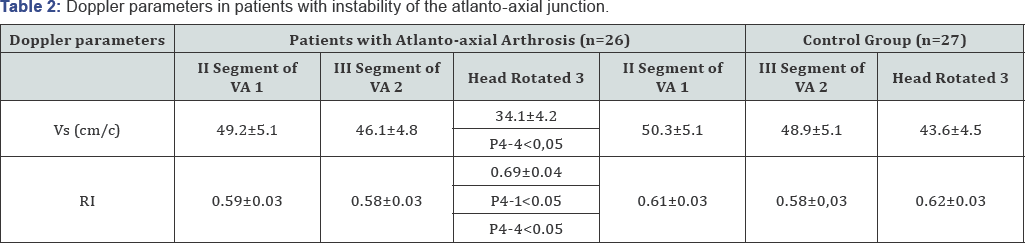
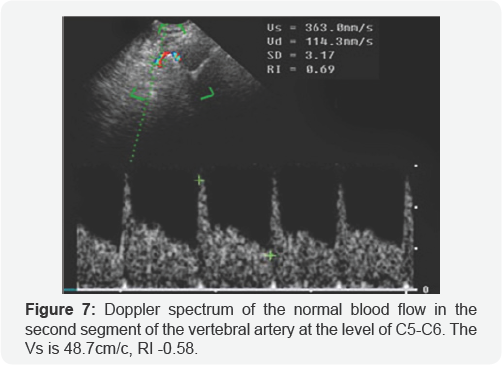
Dopplerometric parameters of vertebral artery blood flow in patients with atlanto-axial instability are presented in (Table 2).
In this patients at the level of C5-C6, Vs amounted to 49.2±5.1cm/s,
RI-0.59±0.03; at the level of 3-d segment of VA-Vs was 46.1±4.8cm/s,
RI-0.58±0.03 (Figure 7).
When the head was turned to the side in patients with instability of
the atlanto-axial junction, Vs was significantly lower compared to the
control group (34.1±4.2cm/s and 43.6±4.5cm/s; RI more then in the second
segment of the VA (P<0.05).
Discussion
Bayrak et al. [10]
studied correlations between the indices of degeneration, the positions
of the cervical vertebrae and the Doppler parameters of the vertebral
arteries. However, they evaluated vertebral arteries in patients with a
head in a neutral position. Rotational Vertebral Artery Occlusion
(RVAO), or bow hunter’s syndrome, most often occurs at the C1-C2 level
on physiological head rotation. It presents with symptoms of
vertebrobasilar insufficiency [11]. Yamaoka Y [12] studied the role of ultrasound in diagnosing the degree of changes in the Atlanta loop with the maximum rotation of the head.
In our study, we assessed vertebral arteries in
patients with arthrosis and instability of the atlas-axial junction and
healthy with a turn of the head to the contralateral side. Because the
vertebral artery passes through the bony transverse foramina, it is
vulnerable to stenosis with head rotation caused by compression by
osteophytes. Therefore, our results suggest that with the rotation of
the unstable atlanto-axial junction compression increases, causing
marked luminal narrowing and reducing blood flow through the vertebral
arteries.
Conclusion
Instability of atlanto-axial junction, especially in
combination with arthrosis, is one of the common causes of cervicogenic
headache in young people. The main pathogenetic mechanism of the onset
of pain is changes in blood flow in the third segment of the vertebral
arteries, especially during rotational movements.
To Know More About Trends in Technical and ScientificResearch Please click on:
https://juniperpublishers.com/ttsr/index.php
To Know More About Open Access Journals Please click on:
https://juniperpublishers.com/index.php
https://juniperpublishers.com/index.php



Comments
Post a Comment